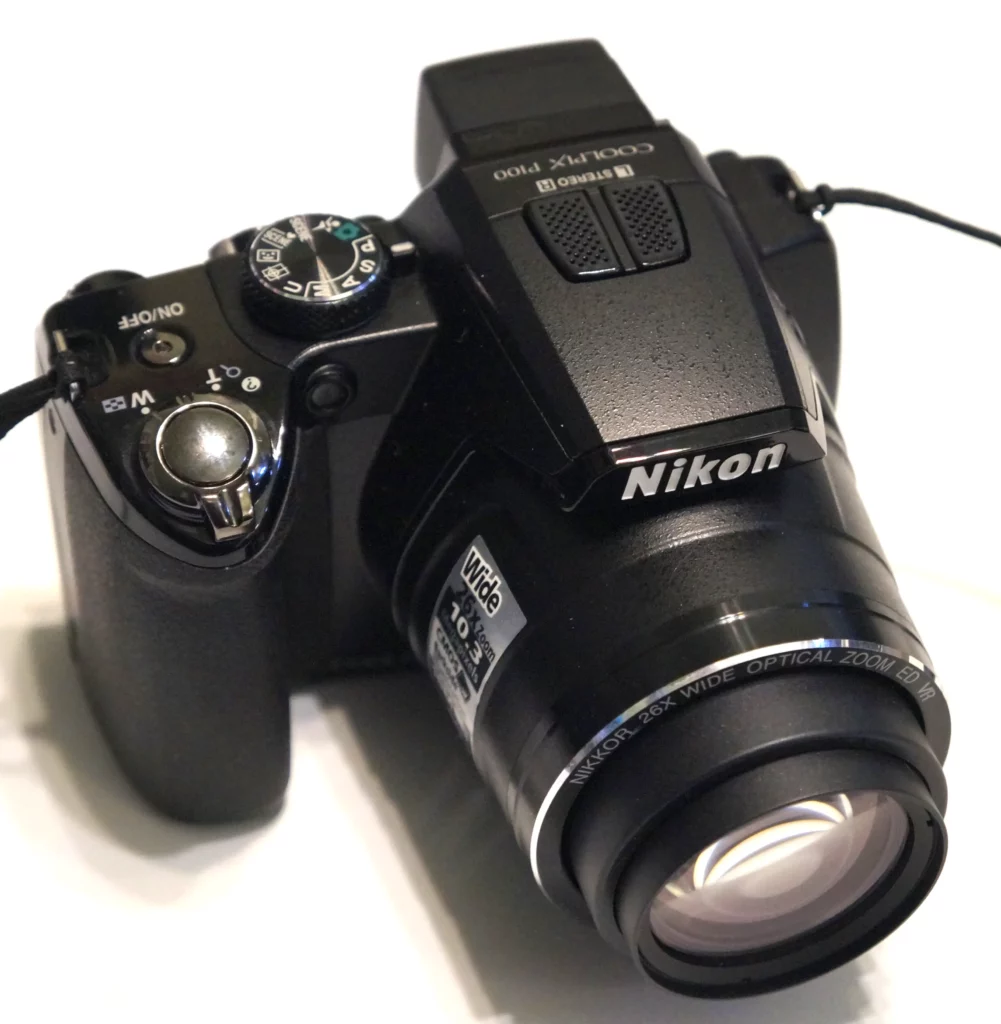
• Quirks of the Nikon COOLPIX P100

    Nikon COOLPIX P100

    This was a pretty good superzoom fifteen years ago, and it still can produce good pictures. It takes more effort to get those good pictures than with most of old Pa Pitt’s other outdated cameras, though, and sometimes he wonders whether the results are worth putting up with its eccentricities.

    First, this camera takes a proprietary battery. Almost all cameras these days do. Camera manufacturers were shamed out of using AA batteries by online rants, but all the online rants Father Pitt has read against AA batteries in cameras start from the same premise: rechargeable AA batteries do not exist. Father Pitt does not know how that incorrect assumption became accepted dogma in the photography world. With good AA batteries, the number of pictures per charge is comparable to what proprietary batteries can do, and the advantage of having one kind of battery for every camera becomes more obvious the more cameras you have. Father Pitt has a lot of cameras, so he tries to look for cameras that use AA batteries. But this camera came at a very low price, so it was worth trying out.

    A more serious difficulty is that the separate battery that runs the clock and keeps the settings is defunct, and it cannot be replaced. With most cameras, this means the minor inconvenience of having to reset the date and time with every battery change. With this camera, though, all settings are reset to defaults with every battery change. That would not be a problem if the default settings were reasonable, but they’re rubbish.

    First of all, this is the only camera Father Pitt owns that does not default to its highest-quality image setting. Fine, Normal, and Basic are the three settings available, and the camera defaults to the middle one. At the “Fine” setting, the camera can store more than six thousand pictures on a 32-gigabyte card, so there’s no good reason to skimp on quality.

    Next is the “AF area mode.” At the default “Auto” setting, the camera hunts around for things to focus on and picks a different one each time, usually the wrong one. Setting the mode to “Center” makes autofocus work reliably.

    Then comes “Distortion control.” Like most superzooms, this one trades a fair amount of lens distortion for its long zoom range. You can set the camera to correct that distortion—but the setting is off by default.

    And here we run into one of the other odd quirks of this camera, which is that you can’t have distortion correction and exposure bracketing, or a number of other things. You must choose one or the other. The manual has a two-page chart, in small print, of “functions that cannot be applied simultaneously”—and it leaves out a lot of things, which you can only find out by experiment. For example, it doesn’t tell you that you can’t use distortion control with auto bracketing.

    Next on our list of bad defaults, we go to the “Optimize image” submenu. Here we ignore the second level of options and pick “Custom,” which allows us to adjust the contrast, sharpening, and saturation, all of which are much too aggressive by default. Father Pitt sets them all to the lowest levels.

    Because the settings are lost every time the battery is changed, this routine has to be repeated every time the battery is changed. To be fair to the camera, it was not designed to lose the settings; they were meant to be kept by the clock battery. But it is also fair to point out that the clock battery was designed not to be replaceable, and online chatter indicates that it failed early in a large number of these cameras. And it is also fair to point out that other cameras do not lose settings when they lose the date and time; other manufacturers found a way to store those settings in nonvolatile memory.

    Finally, one other annoyance: the camera is not smart enough to take the zoom into account when using Auto ISO mode, and the image stabilization is unimpressive. To get a sharp picture at the long end of the zoom, it’s necessary to set a higher ISO speed by hand, and then remember to set it back after retracting the zoom.

    All right, but what about the pictures?

    Well, they’re kind of lousy at the default settings, but once the settings are tweaked, they’re very good for a superzoom. The camera will not save in raw format, but the CMOS sensor compensates for that somewhat. Father Pitt likes to use exposure bracketing, and the three exposures are taken quickly, with the camera ready for another three in a second or two. These bracketed exposures can be made into HDR pictures that preserve a high level of detail in shadows and highlights.

    So, for the shopper looking for a cheap used camera, is the P100 worth it?

    If you have a choice (and that’s what online auctions are for), old Pa Pitt would recommend something else. His Fujifilm FinePix HS10, for example, has the same resolution and came out at the same time, but it is far better at everything it does, and it has more capabilities, including saving in raw format. Also, its internal clock still works.

    But if you see one of these Nikons in a flea market for $5, well, you can get some very good pictures out of it.

    A few pictures taken with the Nikon:

    Highland Towers, Shadyside

    Highland Towers, Shadyside.

    Lonicera periclymenum

    Lonicera periclymenum.

    St. Peter’s Church, North Side

    St. Peter’s Church, North Side.

    Lut’s Meat Market

    Lutz’s Meat Market, Hill District. This is one of those HDR pictures made from three bracketed exposures. The speed of bracketed exposures is one of this camera’s chief recommendations.


  • Easy to Use

    A pocket digital camera was sitting around, and Father Pitt picked it up to see whether it might be worth using. Here are the Modes:

    Scene Recognition Auto

    Auto

    Program

    Natural & Flash

    Natural Light

    Portrait

    Baby Mode

    Smile & Shoot

    Landscape

    Panorama

    Sport

    Night

    Night (Tripod)

    Fireworks

    Sunset

    Snow

    Beach

    Party

    Flower

    Text

    But you can’t control shutter speed, aperture, or focus, because that would be too hard to figure out.


  • Moving Water

    Fountain at Gateway Center
    Fountain at Gateway Center. Notice the fascinating patterns in the falling water.

    Old Pa Pitt would like to have a little electronic device, like a TV remote, that could turn off clichés. Just push the button, and the cliché disappears from our intellectual landscape. And the first photographic cliché he would turn off would be the moving-water cliché.

    Try it yourself. Look up guides for beginning photographers who want to move on to the next level of manual control. When they come to the question of shutter speeds, what is the example they give to illustrate why you might want to control the shutter speed yourself? Four out of five of them tell you that you’ll want to do that to blur moving water.

    Why? Why is moving water supposed to be blurred? Why should it look like strings of cotton candy? It’s unnatural. The only place that effect belongs is on inspirational posters with quotations from C-list poets.

    But it has become a cliché. More than that: it’s a dogma. You have to blur moving water. It’s your duty as a responsible photographer to smooth out rapids and waterfalls into white streaks.

    Why? You don’t see moving water that way when you look at it. You see an irregular surface, constantly changing, and the thing that is most characteristic is its chaotic irregularity. This characteristic is exactly what is removed by deliberately slowing the shutter speed to turn the water into a white streak.

    But we can admit to ourselves that it produces some pictures that attract attention. At least they do the first five or six times you see the effect. After that you begin to get a bit tired of it, don’t you? By “tired” Father Pitt means that you simply don’t notice those pictures anymore. If you are forced to pay attention to them, you may tell the photographer that they are very nice, and the word you would use to describe them is restful. In fact they are a perfect cure for insomnia, especially if they are adorned with quotations from C-list poets.

    So what should we substitute for this cliché? We can’t just take regular pictures of moving water, can we?

    Well, yes we can. In fact, to counteract the cliché, it might be good to use the fastest shutter speed possible for moving water. You’ll capture drops suspended in the air, wavelets in the act of breaking, and other fascinating things that will actually give people something to look at, as opposed to a smooth and undifferentiated white streak.

    In fact you’d probably get better results by leaving your camera on full auto mode and snapping your picture than by deliberately slowing down your shutter to achieve the effect that the textbook says you should use, the effect that will put every viewer to sleep.

    Of course, the other great thing to do with moving water is to take movies. Water in motion is an endlessly fascinating subject for the kind of videos that most digital cameras or smartphones can do very well; and since most pictures are seen on screen these days anyway, there’s no reason they shouldn’t move.

    But don’t slow down your shutter to blur moving water. If you feel tempted, try some other cliché, like extreme wide angles. Someday soon Father Pitt will tell you how much he hates those.


    Comments

  • The Picture Is the Thing

    Baywood Street, East Liberty, Pittsburgh
    A natural-looking picture of some houses on Baywood Street in East Liberty. To make this picture, Father Pitt took three different exposures (with a little Kodak pocket Z1285 that will bracket exposures automatically), adjusted the perspective to look like nature, and fiddled with the colors to match the way he remembered the scene looking to his own biological eyes.

    Father Pitt is a pictorialist. That does not mean that he expects to emulate the impressionistic style of the Pictorialists like Steichen in his early days, but that the picture, in his opinion, is the thing that matters, and not how the picture was obtained. A picture ought to be judged by how it looks, and not by some theory of what photography ought to be. If you produce a pin-sharp rendition of everything in front of your lens, good for you. If you produce blurry impressionistic shapes, good for you. The question is simply whether those shapes make a picture we want to look at, or whether those sharp details belong in the picture you’ve made.

    For that reason old Pa Pitt has no objection in theory to any kind of processing you put your picture through to get the result you want. The Pictorialists of 1900 would rub and scrape and torture their prints to eliminate details they thought detracted from the effect they wanted. A modern photographer can do the same with the GIMP or Photoshop or Affinity Photo.

    While you have only begun to think it, Father Pitt will hasten to add that much of what people do with image-editing software is in egregiously bad taste. Most of what most people do with anything is in egregiously bad taste, so we can’t expect them to be any more tasteful with powerful image-manipulation software in front of them. One thing that could be said in favor of the old print-torturing techniques of the Pictorialists was that they took a lot of effort, and therefore automatically excluded casual fiddling. By the time you had developed the technique and the patience to manipulate pictures that way, you might have absorbed some aesthetic sense, too. But not always: see the works of William Mortensen (you can find a selection on the Photography page of Dr. Boli’s Eclectic Library) for examples of laborious print-torturing in the service of sometimes appalling taste.

    For his own pictures, Father Pitt thinks of the photograph as the raw material for a picture. Most of the time he is not attempting art: he is trying to illustrate what a thing actually looks like, and the way the camera sees must be adjusted to make it match the way human brains perceive. Thus the perspective of buildings is adjusted, the highlights are darkened and the shadows lightened, and the colors are adjusted to match what the human mind naturally does when it processes a scene.

    This is not what photography ought to be like. It’s only what Father Pitt does to make the pictures that suit his purposes. Some photographers set a rule for themselves that the picture must go straight from the camera to publication, and if they get good pictures that way, then they’re doing it right. Father Pitt has little patience for abstract theories of what photography ought to be. He has more opinions than anybody needs. But if you can make a good picture by ignoring every one of them, then good for you. The picture is the thing.


  • Developing Black-and-White Film with a Monobath

    Tombstones in Clinton Cemetery

    Years ago, when old Pa Pitt was taking pictures mostly on film, he used to develop black-and-white film on the kitchen counter. It was not difficult. Instead of a darkroom, he had a changing bag, which is a portable darkness with holes for one’s wrists, and a daylight tank. Once the film is loaded into the tank inside the changing bag, everything else can be done in broad daylight.

    There are several steps to traditional film developing. First pour in the developer and slosh it around in the prescribed way: this sloshing is called agitation, and there are important chemical reasons for it that would be boring to go into. Then pour out the developer and pour in a stop bath, which stops the development. Then comes the fixer, which makes the film lightproof, so that you can actually see the negatives without turning them all black. Then you rinse the film, and if everything went right you have pictures—negatives, that is, which can be scanned or printed to make pictures you can look at.

    A monobath promises to simplify that process by bundling the developer and fixer into one solution. The idea is that the developer works fast enough to outrun the fixer; once the development is done, the fixer does its work, and once you’ve rinsed off the chemicals, you have developed and fixed negatives in one step.

    Now that Father Pitt is picking up film cameras again, the economy and speed of developing the film himself are once again appealing to him. When he heard about the idea of a monobath, he decided to try it. It worked the first time, so here is a description of the experience for anyone who might be considering doing the same.

    For his test roll, Father Pitt took an Argus A, a cheap and not very capable camera from the 1930s, to Clinton Cemetery. He was also taking digital pictures, so if the whole roll was wasted, the only loss would be the price of the film. It was Kentmere Pan 100, which is some of the cheapest black-and-white film you can get, and in spite of its cheapness Father Pitt has almost no complaints about its quality. The one small complaint is that this particular roll seems not to have been attached to the spindle in the cartridge. You should know that the film is at the end when you can’t turn the winding knob (or push the advance lever for you fancy types whose cameras are newer than ninety years old). This roll just wound all the way out; we knew it was done because the rewind knob stopped turning. Fortunately the roll was destined for the changing bag anyway, but it would have been very inconvenient if Father Pitt had been planning to take it to the lab.

    For processing, Cinestill offers a “Df96 Mono Film Processing Kit” that includes much of what you need to get started: the chemical solution, a small daylight tank for one roll of 35mm film, and a funnel with mesh filter (that’s important, because you’ll reuse the chemistry multiple times). If you don’t have a darkroom, you’ll also need a changing bag, and you’ll definitely need an accurate thermometer. It also helps to have a small tub that you can fill with water to maintain the right temperature in the chemistry.

    Temperature and agitation are everything in this process. It is more or less self-timing: at a certain temperature, with a certain amount of agitation, the developer will do its job in time before the fixer is finished. A shorter time would not produce the result you want, but a longer time doesn’t seem to make much difference.

    Since the temperature is so important, Father Pitt filled a tub with water at just a degree above the proper temperature and set the bottle of solution in it for a while. When the thermometer showed that the solution was at the right temperature, he poured some of the bath water into the tank with the film and left it in there for a minute. Then he poured the solution into the tank, followed the agitation instructions, and waited till the time was up. After that, he poured the solution back into the bottle and rinsed the film according to the instructions. Then he took it out and hung it up to dry.

    It was obvious from a glance that the film had developed, and when the film was thoroughly dry scanning the negatives showed that nothing had gone wrong with the development process. Some online sources say that monobath developing increases the grain, and that may be true; we can only say that the grain seemed to compare favorably with the grain in the same brand of film processed by a local lab.

    Well, this seems like a good way to get film developed with minimal effort. In the whole process, the hardest part was getting the film on the plastic spiral reel in the changing bag, and Father Pitt will share one hint that seems to have made that part much easier. Cut off the corners of the end of the film that goes into the reel: those sharp corners want to catch on everything, and smoothing them out seemed to make the film slip into the reel much more easily.

    For his next roll, Father Pitt will try the same process, but with a better camera.

    McBride plot
    Argus A with Kentmere Pan 100 film.

    Update: Here is an example of a picture from a Kodak Pony 135 (which is a simple camera with a good lens) on Efke KB 25 film, developed in the same monobath chemistry:

    Ohio Valley Trust Company
    Kodak Pony 135 with Efke KB 25 film.